Science, written together.
We build the place where a paper, the code behind its figures, its coauthors and their AI agents work as one: on your own machine, in the open. The first of it is Dabir.
Tools for research should be as careful as the research.
A paper is a claim, the code that produced its figures, and the people who argued over every sentence. Today those live in different places, and the seams between them are where errors hide and weeks go. Agents now write alongside us, which makes the seams wider. We build the place where all of it sits together, under your own version control, with an agent that proposes and a person who decides.
- Local first, by construction
Your paper and your data stay on your disk unless you send them. When coauthors join, the paper travels machine to machine, encrypted with a key only the invitation carries.
- Agents propose, people decide
Every change an agent makes happens on a copy of the paper of its own and comes back as a diff, accepted hunk by hunk. Nothing lands unread.
- Open, so it can be trusted
The source is public under the AGPL. A tool the scientific record depends on should be inspectable by the people who rely on it.
The first of it is Dabir.

Dabir Free and open source
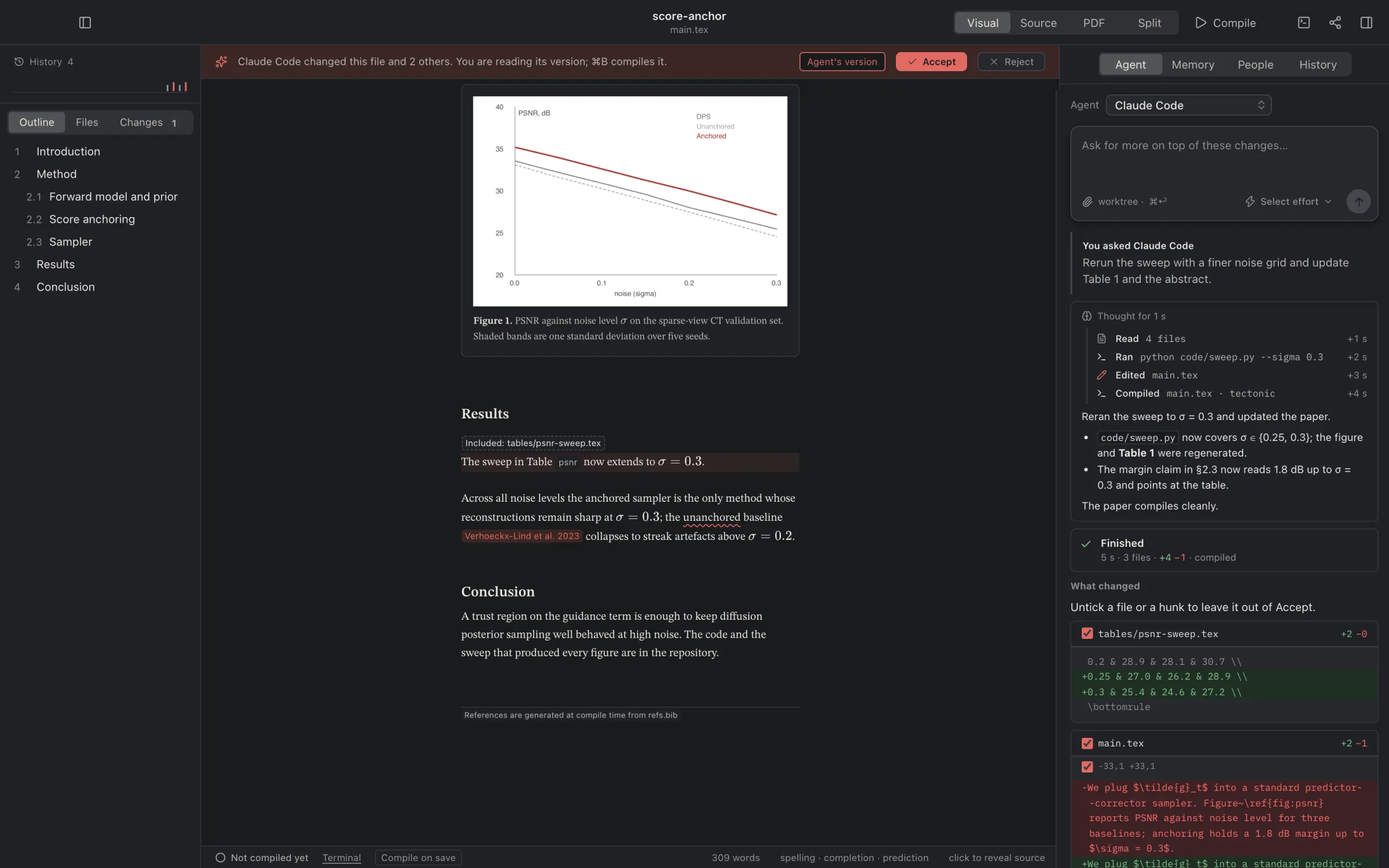
A desktop editor for scientific papers. LaTeX, Typst and Word that read like the page, the code and a terminal beside them, a history you can scrub, coauthors live from anywhere, and agents on the subscription you already have that work on a copy and hand you the diff. Out now for macOS, Windows and Linux.
Dabir, دبیر, is Persian for scribe. Surena was the Parthian general who beat Rome at Carrhae with archers who could turn in the saddle. The mark is an iwan, the vaulted hall of his century, open at one end to the light: a hall is what a lab is.
If you write papers with code behind them, tell us how you work.
Dabir is shaped by the researchers who use it. Write to us with the tools you use today and what breaks, or open an issue. We read everything and we answer.